
Blog
Generative AI-based structured problem solving in manufacturing
Veröffentlicht am
19.1.2025

Industrial manufacturing thrives on the expertise of its front-line employees, whose skills and decision-making skills are second to none. But this human dependency poses challenges, such as the loss of institutional knowledge due to the retirement of workers and shorter employment contracts among younger generations. How can companies preserve this important expertise and make it available to all employees regardless of their experience? oee.ai has the answer with its generative AI-powered structured problem-solving feature, which transforms human insights into actionable, multilingual instructions. The result? Faster repairs, reduced downtime, and measurable improvements in Overall Equipment Effectiveness (OEE).
Industrial manufacturing relies heavily on people—operators who have sophisticated sensory skills, exceptional dexterity, sensitive handling skills, and unmatched decision-making skills. A big thank you to our dedicated frontline factory workers for their invaluable contributions!
However, this dependency also poses challenges. Globally, the aging workforce is a growing trend, and when experienced employees retire, decades of invaluable knowledge often go back with them. Younger generations are now changing jobs more frequently, which means they spend less time mastering the intricacies of operating plants at maximum efficiency.
The solution? Companies must capture and preserve the expertise anchored in the minds of their employees. This is where the generative AI-based structured problem-solving function of oee.ai comes into play, which preserves and uses this crucial knowledge for long-term success.
The process is simple and extremely effective. It starts with recording the expertise of various employees. Whenever a system fails and is repaired, oee.ai prompts the operator to document the cause and solution when restarting. This can be done in any language, either typed or spoken directly to oee.ai.

Knowledge collection takes place over a longer period of time, in particular when it comes to a complex loss base catalog. By recording multiple cases of each loss — ideally from different employees — comprehensive coverage is ensured. A detailed catalog allows employees to document more accurate troubleshooting advice, which later leads to even more specific and actionable insights.
The data is processed by our generative AI module, which converts it into clear and concise instructions for plant operators. The AI generates simple, easy-to-understand instructions, often in bullet points or short sentences, without limiting the output language. Regardless of whether your plant is operated in the USA, Poland, Italy or Germany, oee.ai provides consistent knowledge to solve the root causes of problems in any language and at any location.

The collection and training process includes a human-in-the-loop approach to ensure quality control. This crucial step is usually carried out by shift supervisors, maintenance personnel or very experienced operators. Through this additional verification, the AI-generated content can be refined, adapted, or completely overwritten. For example, if a specific plant problem requires the attention of a trained electrician, this can be stated. This collaborative process ensures that problem-solving knowledge remains accurate, secure, and aligned with operational best practices at the root cause.
As soon as the knowledge base is online, oee.ai provides operators with a list of suggested solutions for the cause of the problem directly on their tablets or other devices, whenever the specific loss occurs. This functionality works seamlessly with the automatic recording of loss reasons from the PLC, but can also be used with manual loss cause entries. With these findings, even less experienced operators can quickly determine the appropriate corrective measures or, for example, make a well-founded decision to call a maintenance specialist. This speeds up the mean repair time (MTTR), minimizes downtime and ultimately improves overall equipment effectiveness (OEE). This feature is configurable for all three major loss categories: availability, performance, and quality, and ensures comprehensive support for streamlined operations.
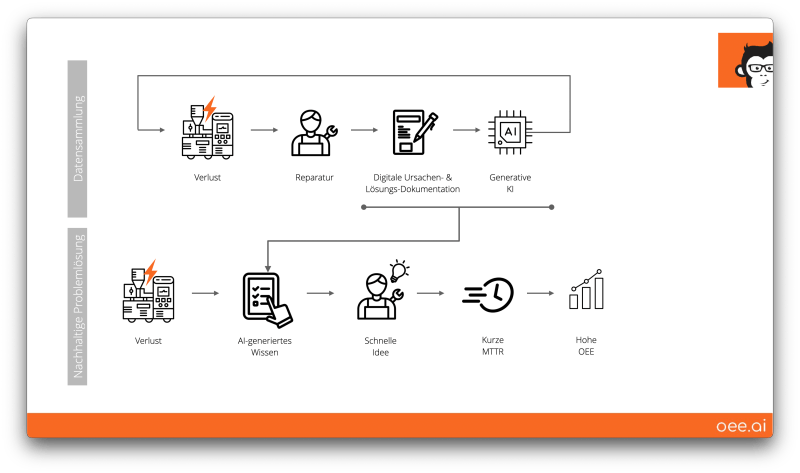
Based on oee.ai's extensive experience, implementing our solution results in an average 10% reduction in average repair time (MTTR). The resulting OEE improvements depend on factors such as the structure of losses and the ability to precisely define and communicate effective countermeasures.
For all systems we monitor, OEE improvements are typically between 2% points at the low end and up to 5% points at the high end. The improvements depend on current OEE figures. These gains illustrate the significant impact of precise problem solving and efficient corrective measures on plant productivity.
If you're interested in how oee.ai can help you gain a competitive advantage in your industry, don't hesitate to contact us at info@oee.ai.