
Blog
Affordable, flexible and professional system connectivity to increase OEE
Veröffentlicht am
8.1.2025

The lack of connectivity between industrial systems is one of the major — if not the biggest — hurdles when digitizing manufacturing. The plant park is heterogeneous, the solutions require individuality and are, as a result, expensive. But products are gradually coming onto the market that simplify the connectivity process and thus reduce costs. We are presenting a variant with which we have had very good experiences: The SICK TDC in combination with Node-RED.
In generic terms, the process of plant connectivity to optimize OEE consists of 3 steps.
- Recording of production units
- Preparation of the signal for forwarding
- Digital data delivery to oee.ai
This often requires both additional hardware and software in the systems.
Note: The following description can be used in various environments. However, it is not a universal solution for every use case. Based on the number of installations, we have now built up a wealth of experience in designing good connectivity. If this use case is not yours, feel free to contact us personally.
Recording production units
The basis for calculating OEE is the number of units produced over time. This quantity vector must be provided in real time by the production process for oee.ai. This is regularly done in one of 2 variants.
The retro-fit variant consists of attaching an additional sensor to the system, which detects this signal, or splitting the signal from an existing sensor.
A second option is to read the signal from the system's PLC. This is necessary, for example, when it is not just a single sensor that is decisive for representing a number of pieces. The PLC can then form the quantity signal by processing these sensors. With the help of a free output, this can then be derived from the controller.
Now, the signal from the production units is present at the end of a cable in one way or another. The next step is processing the signal.
Signal processing and dispatch
Both hardware and software are required for song processing and dispatch. Let's start with the hardware.
SICK TDC as connectivity hardware
SICK released the first-generation Telematics Data Controller (TDC) product range some time ago. This hardware can be installed alone or in a control cabinet on a DIN rail.
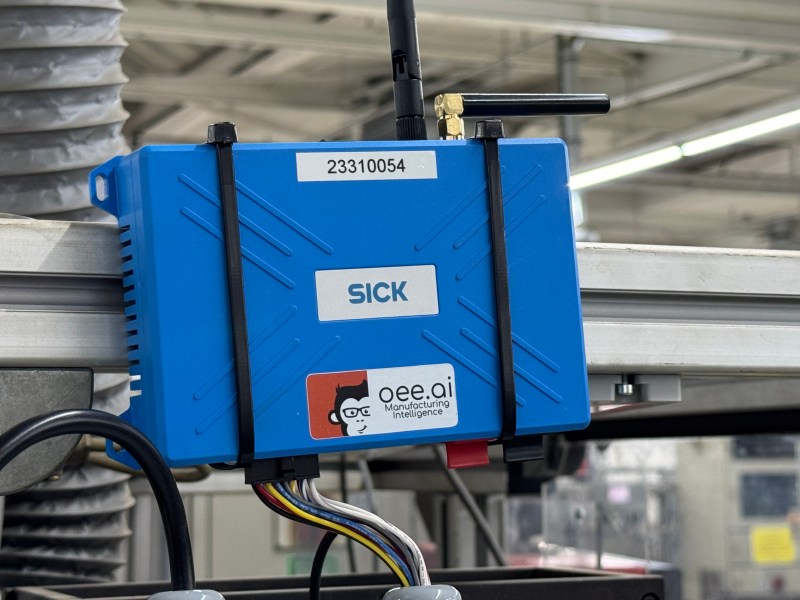
Up to 6 systems with analog signals can be connected to the TDC, which significantly reduces hardware costs compared to other infrastructures. This requires a cable connection from the system to the TDC.
The system signals are received by the previously prepared signal cable. Depending on the model variant — which also influences the price — the TDC sends data via network cable, WLAN or mobile communications.
In this way, a price-efficient path for the signal from the system was placed into connectivity hardware. In addition to the comparatively low hardware costs, the TDC product family is designed as an open platform for software. More about that in the next section.
In the SICK product catalog, you will find the SICK TDC in its variants here.
Node-RED as connectivity software
The signal for calculating the OEE is now in SICK TDC and must take the next step from there to the oee.ai cloud application.
As already mentioned above, software can be flexibly installed on the SICK TDC.
The TDC essentially virtualizes so-called 'containers with the help of Docker. ' These run independently of each other on the TDC. Installing a container is very easy and provides an uncomplicated and open way to operate various functions on one device.
We make use of this option and install the Node-RED open source low-code programming environment on the TDC. Due to its simplicity, Node-RED is also spreading at high speed in industrial environments and is used for signal processing and transmission to oee.ai.
To further simplify the installation process, oee.ai has provided a Node-RED Flow in the Open Source Library specifically for SICK TDC, which you can here find.

The software stack described here is available completely free of charge and can be adapted to your own needs with only a little programming knowledge if required. The oee.ai team is also happy to answer questions and provide assistance.
The entire chain of connectivity via hardware and software has now been mapped. With our own know-how in the Node-RED environment, this connectivity only costs SICK hardware. Even if you still buy some software support, this tech stack enables inexpensive connectivity based on professional hardware and software for many use cases.
Do you have any further questions? Please feel free to contact us at info@oee.ai. We are looking forward to the discussion.