

The targeted management of plant productivity is becoming more prominent in the order of priorities of companies. The relocation of added value to Europe, rising energy costs and the ever-declining availability of employees motivate managers to make the best possible use of existing resources. But where can you develop? What is the benchmark in OEE management against which you have to be measured? This article provides information.
The start of effective OEE management dates back to an old saying: “What is measured is done.” The origin of this statement probably dates back to Rheticus in the 15th century, and the original statement is more likely to have been “if you can measure it, you can manage it.”
Regardless of origin or wording, the message is clear: Measuring something produces the information you need to ensure that you achieve what you set out to do. This is the initial step on the way to the OEE management benchmark: Automatically measure whether the system has run every single minute at the specified speed (run according to the shift plan, speed according to the specified time) at which it should run. With the current state of the art, this is easily possible via a connection to the system control system.

Step two is then to obtain reasons for the minutes that you have lost or in which the system has run too slowly or has produced rejected parts (loss of availability, performance and quality). These can also either come from the controller or be entered by the system operator on a display or terminal.
In step three, the data is visualized on a large display in real time and close to the plant. This creates responsibility among plant employees and offers managers a good start to a spontaneous discussion about the productivity of the current shift.
Based on experience, visualization and the associated transparency of plant effectiveness alone result in an OEE increase of 2-5%.
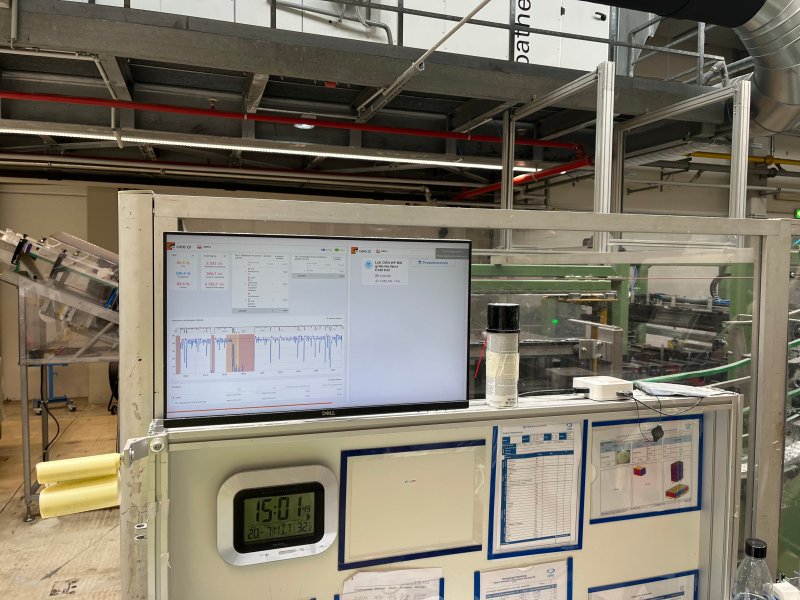
In morning shop floor management, in step four, the top three productivity losses of the past period are discussed and, if necessary, added to the problem-solving process. This routine forms the formal bridge to management and is timely enough that there are still reminders of the specific circumstances of the losses.
In addition, trends are analysed once a month and major improvement projects are discussed, in addition to daily routines.
In step five — usually with the support of manufacturing engineers — the problems are worked on and then solved.
These resolved issues are checked for effectiveness in the “Act” phase of the PDCA. This is the sixth and final step in a professional OEE management process.
This is the modern benchmark process, supported by Industry 4.0 technology, of continuously increasing plant productivity, as the oee.ai team has in mind as a target state.
Feel free to contact us if you want to develop yourself in order to sustainably increase plant productivity in your area of responsibility.