
Blog
From KPI to Insight: Conversational AI as a Complement to Dashboards
Published on
6.11.2026
Dashboards and reports are the common foundation for shop floor management and continuous improvement in many manufacturing plants. Everyone works with the same KPI definitions. Machines, shifts, and locations can be compared, and you can see whether a measure is effective over time. In practice, however, the real answer often lies behind a follow-up question for which no report has been prepared.
This article describes how conversational AI bridges this gap. We are referring to the evaluation of data through dialogue and natural language. We will show you what kind of questions can be answered this way and what our customers are experiencing with it.
Limitations of standardized dashboards in everyday production
A dashboard shows what was defined when it was set up. This includes, for example, OEE (Overall Equipment Effectiveness) and its factors: good parts, scrap, and downtime per shift. This is perfect for a running overview and the Andon board in production.
It becomes more difficult with questions that only arise from the situation at hand. One example is the OEE of the last hour before each shift change; another is the cost of a specific loss reason during the current month. There is usually no ready-made report for such questions. Anyone who needs the answer has to build an analysis themselves. Or the question ends in a meeting with, "I'll look into it and get back to you."
Conversational AI as a supplement to the existing data basis
Conversational AI builds on this data basis rather than replacing it. In oee.ai, the AI assistant is called Saru. Saru is available as a chat directly in the oee.ai frontend and as an "oee.ai" app in the App Store and on Google Play. Compared to a dashboard, usage changes in five ways:
- Questions in natural language: No prior knowledge is required for an analysis.
- Answers in dialogue: The context is built up within the chat. Follow-up questions refer to the previous answer.
- AI as a sparring partner: Saru puts the figures into perspective and suggests solutions that the team can then discuss together.
- Additional parameters: Contribution margins or hourly rates can be included directly in the question.
- Ad-hoc answers: Results are available in seconds, not after a subsequent analysis.
Application examples from everyday production
Preparing for the shop floor meeting.
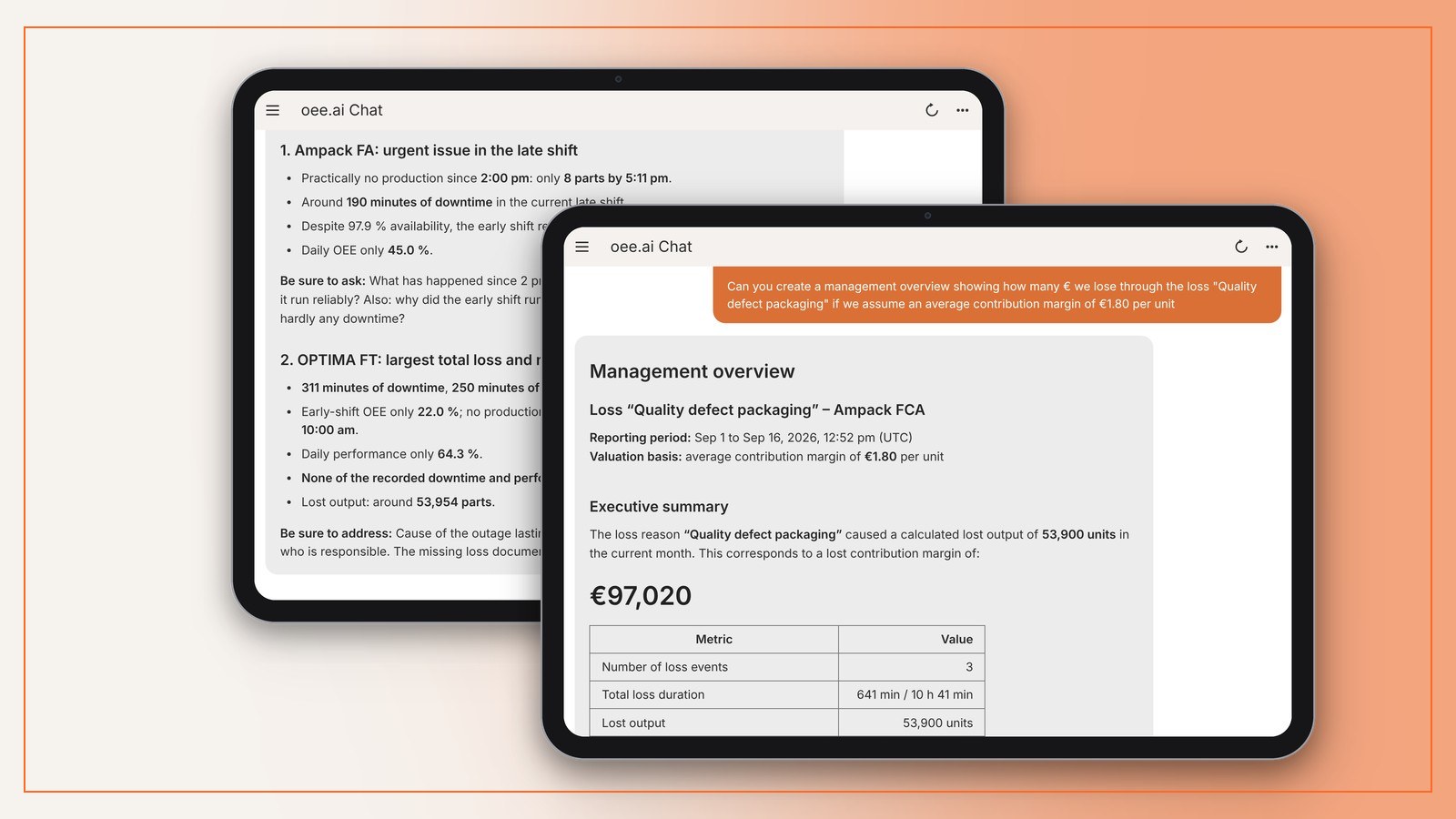
The question is: "I have my shop floor meeting for the filling area shortly. Which topics should I prioritize today?" Saru summarizes the day's KPIs and lists the points for each machine that should be addressed in the meeting. In this example, one machine was idle for 250 minutes during the morning shift alone, totaling 311 minutes for the day. No loss reason has been recorded for any of these losses.

Verify a hypothesis and calculate its value in euros.
Were there significant losses this month due to packaging quality issues? Saru identifies three events totaling 641 minutes and a calculated output loss of 53,900 units. This represents the largest single availability loss for the line. Using an average contribution margin of 1.80 euros per unit in the follow-up query, Saru generates a management summary: 97,020 euros.

Check master data.
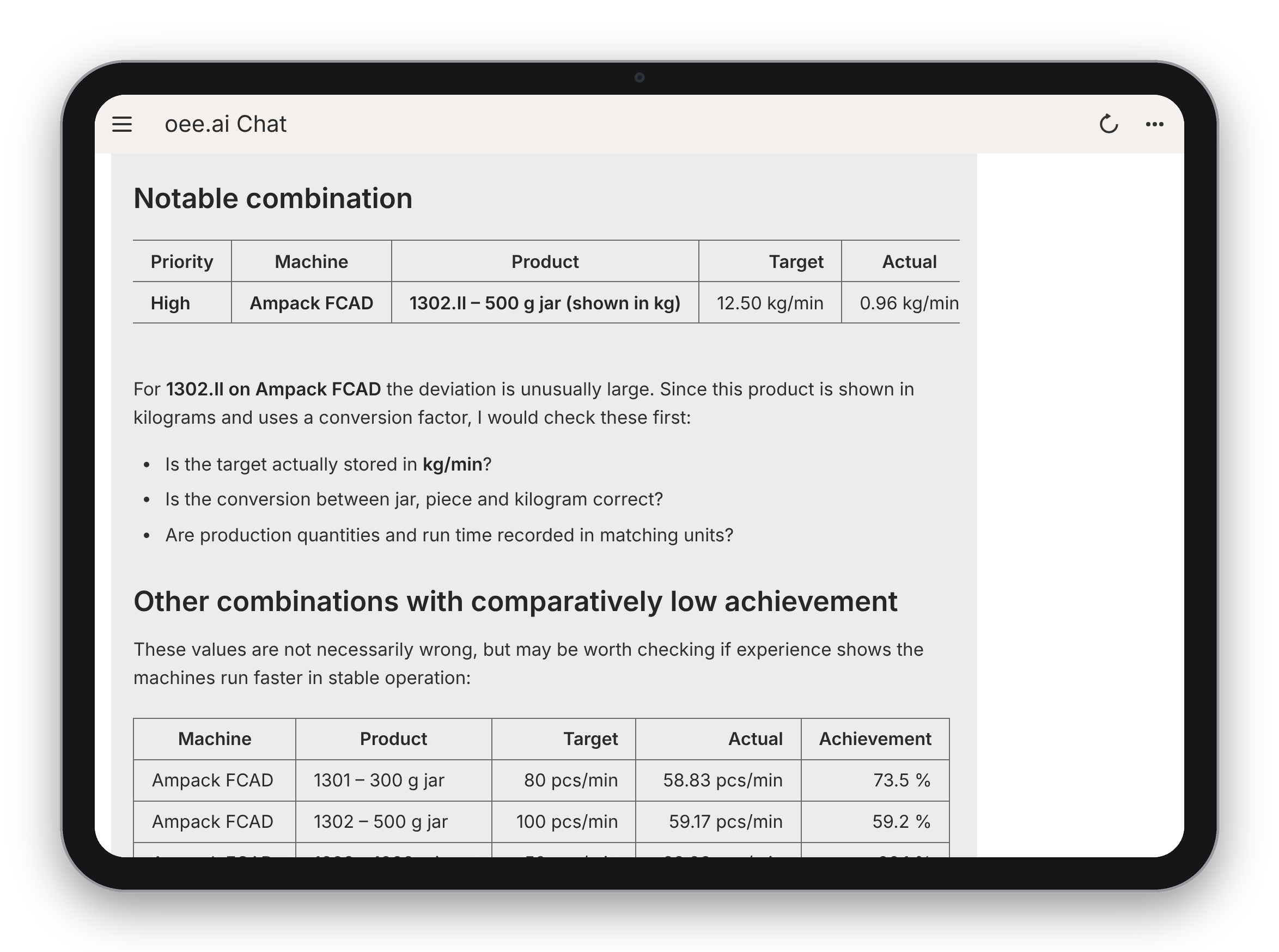
Saru compares the stored target speed with the actual operating speed for each product and machine over a one-month period. For a product measured in kilograms, the discrepancy is so significant that Saru recommends verifying the unit and the conversion factor.
Derive action items.
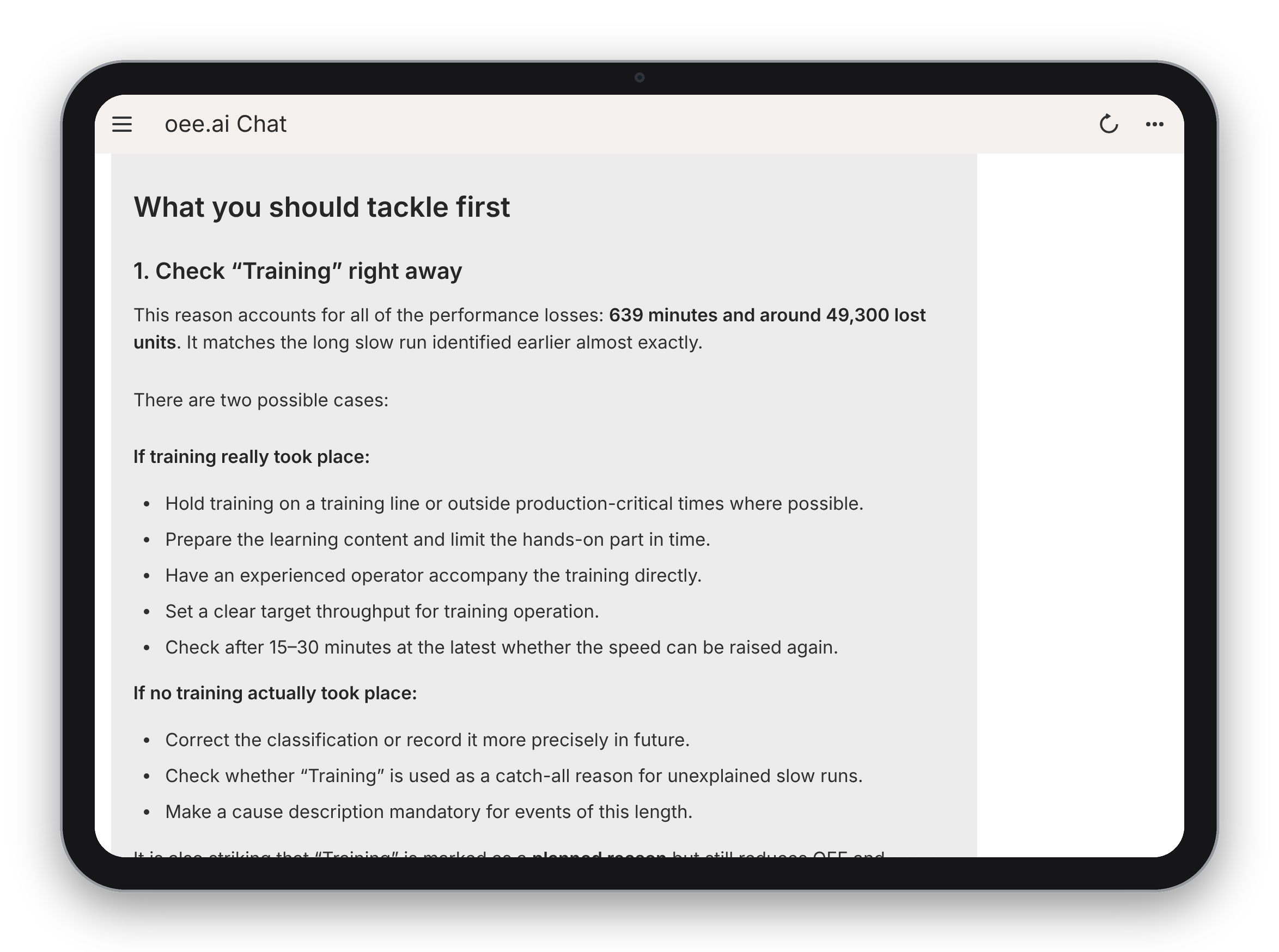
For the 500g jar, 639 minutes are attributed to the loss category "training." Saru distinguishes between two scenarios here: If training actually took place, it should be scheduled outside of production-critical times and have a clear target throughput. If no training occurred, the data entry must be corrected.
Saru vs. MCP Server
With Saru, we provide the AI. The model is maintained and continuously updated by oee.ai, and Saru is ready to use as soon as it is enabled in your user profile. In addition to Saru, we offer an MCP server (Model Context Protocol). With the MCP server, you connect oee.ai to your own AI environment once via mcp.oee.ai and choose the model yourself. The AI can then additionally access everything connected within your infrastructure, such as other systems or files. Here, too, it only sees the data for which the user is authorized.
If you would like to enable Saru for your team or connect the MCP server, please feel free to contact us directly.