
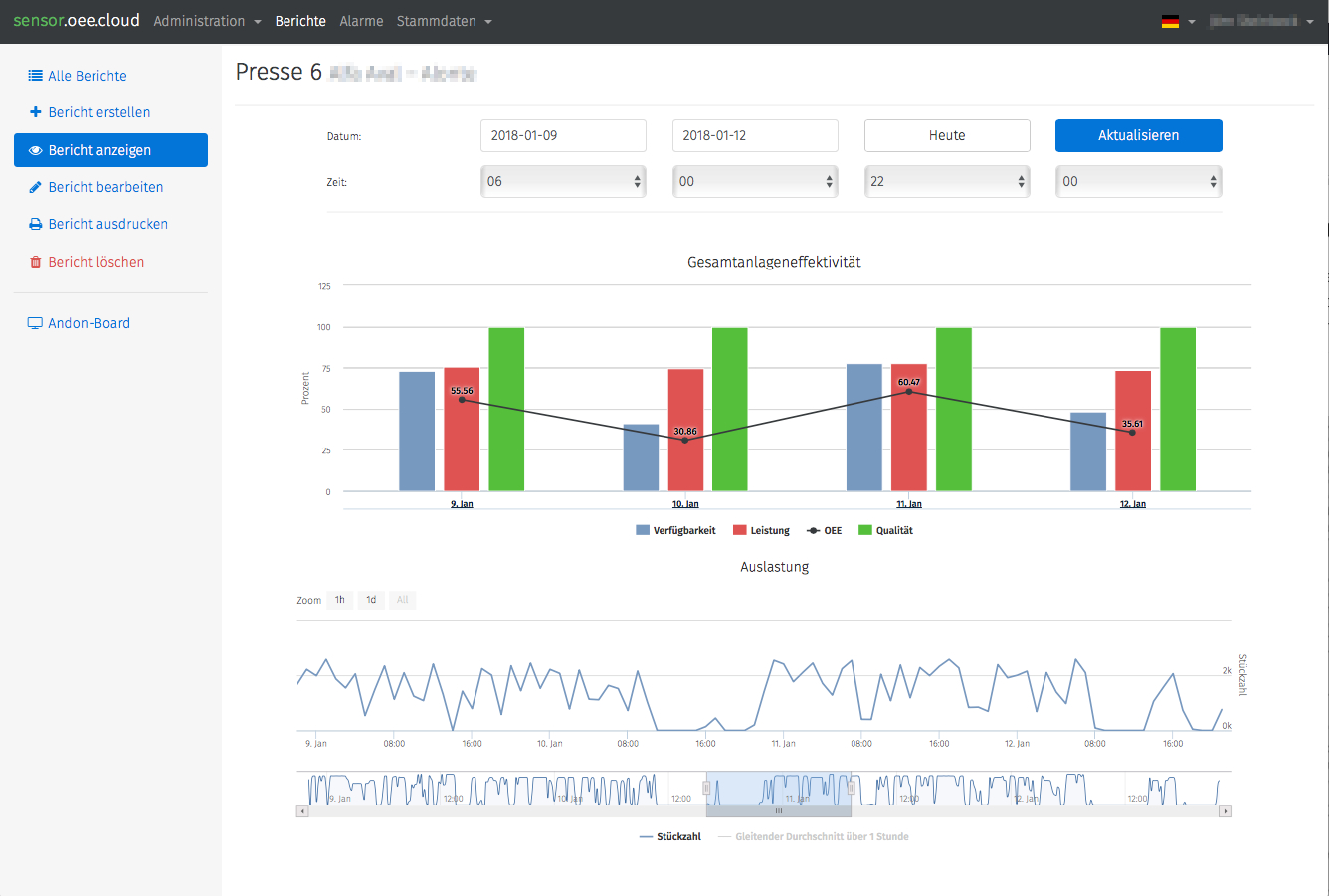
Overall equipment effectiveness (OEE) or overall equipment efficiency (OEE) is a key figure for measuring the productivity of plants. The key figure and in particular the necessary accompanying information are not easy to record, but they have invaluable value for managing plant productivity, which is also known as OEE management. With oee.ai, the hurdle to analyzing and optimizing OEE is minimal, meaning that an improvement process based on figures, data and facts is significantly easier to install than in the past.
OEE is a key figure that consists of the three factors availability, performance and quality. The OEE is calculated by multiplying the factors. OEE is assigned thematically to Total Productive Maintenance (TPM) and Lean Production. What both concepts have in common is that they want to identify and eliminate or reduce waste. In the course of the analysis, a process is divided into added value and waste and the respective shares are made measurable. On this basis, the process can then be optimized through OEE management.
The OEE availability factor and its optimization
Availability losses are downtimes above a limit value, which must be determined on a case-by-case basis. In oee.ai, you can set a limit of > 1 minute at will. All downtimes above this limit reduce availability.
Typical availability losses include major defects, set-up processes, missing materials or personnel, waiting for maintenance — anything that results in a prolonged downtime of the plant. Each time such a standstill occurs, a prompt appears on the tablet for an error reason. These availability problems are often the starting point for OEE optimizations, because the causes are regularly very transparent and are therefore regarded as low-hanging fruits.
For the loss reason “set-up”, SMED (Single Minute Exchange of Dies) has even developed its own method within lean production to reduce these losses.
The OEE power factor and its optimization
The power factor is reduced by short shutdowns or even micro-stops and a system speed that is lower than the specified speed. These causes of loss are often difficult to grasp because although the system is apparently running, it is more often short or running too slowly. Both things that are not regularly noticed when you are at a plant for a short time.
Within oee.ai, these causes of loss are assigned to a separate root fault catalog. A command prompt is issued on the tablet if an OEE limit is not reached over a defined period of time. For example, you can configure oee.ai so that a fault reason is queried if the system is operated for more than 15 minutes with an OEE < 60%. This procedure also makes it possible to assess the losses that would otherwise “run through your fingers.”
The OEE quality factor and its optimization
The quality factor indicates the ratio of good parts to rejected parts. For this purpose, a separate sensor is attached to a scrap/n.i.o. line, which counts the bad parts there. Here, too, the logic is identical. With an independent fault index, fault reasons are assigned to the rejected parts on the tablet.
The quality factor is regularly a lower priority in OEE optimization, as our own departments are concerned with the issue of quality. However, oee.ai is ready for this use case.
Configuring oee.ai
All configurations of oee.ai are carried out via a user interface in an Internet browser. There is no need to install software on the appropriate computer.
oee.ai is designed in such a way that sensors can be moved at any time and the data does not get mixed up. Sensors can therefore be logged off from one location and logged on again at another location. If you return to a location, the previously recorded data is available again as comparative values. In this way, a plausible before-and-after comparison within the OEE.ai reporting system is possible at any time. This makes OEE management easy.
What now?
We've sparked your interest. Contact us at info@oee.ai or call us: +49 (0) 241/401 842 75. We will be happy to provide you with oee.ai sensors and access to the analysis cockpit for a test period. Only then do you decide. We're easy at this point too!