
Blog
Predict the time until the next plant downtime with artificial intelligence
Veröffentlicht am
17.4.2023

oee.ai's artificial intelligence algorithms analyze plant productivity 24×7 and thus help employees increase plant productivity. From the library of available algorithms, in this article, we present the AI algorithm “Subsequent Loss Prediction”, which predicts the time until the next plant downtime.
The technological basis of the function is the Long Short Term Memory (LSTM) algorithm, which, in colloquial terms, has a short-term memory. This memory is used to analyze the data situation just before the standstill in order to identify a resemblance to other situations from the past.
The prediction question is presented as a classification problem for the algorithm. We therefore form classes in steps of 10 minutes, for example, and expect the algorithm to answer how high the probability is that, based on its knowledge from short-term memory, the next disturbance in the cluster will occur from this point in time, from 0 to 10 minutes, 10 to 20 minutes, etc.
For training purposes, past data in the time series database is used, although in principle, more training data generate a higher precision of the prediction. From experience, we can say that at least 3 months of data history must be available for basic training.
The training is plant-specific. So-called graphics processors (GPUs) are used for this purpose, which are used in consumer products, e.g. in gaming PCs. GPUs are specifically designed for this type of computation and are therefore so fast that the model can be retrained regularly. Since changes are the order of the day in an industrial environment — new products, different employees, etc. — we at oee.ai rely on retraining the algorithm once a week.
For training, the algorithm is provided with various parameters, including the current fault reason, which are then processed over several levels in the LSTM model.
The accuracy of the algorithm for the respective system is already known immediately after training — it is calculated as a by-product by the training infrastructure. Depending on the existing data quality and the configured algorithm parameters, an average prediction accuracy of 80+% can certainly be achieved for this problem.
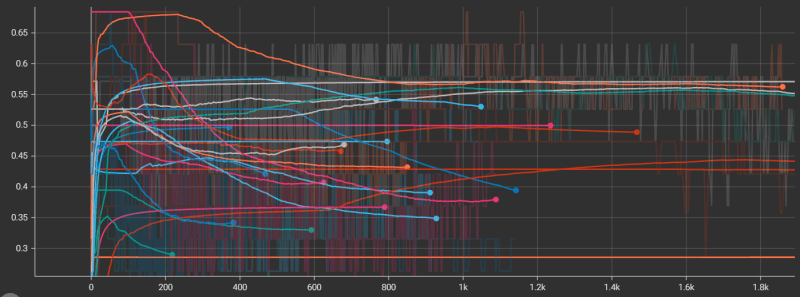
Unfortunately, due to the great influence of the data quality supplied, an experienced data scientist cannot predict the quality of the forecast before the start of the project. This information is only available once the algorithm has been configured in detail and a training run has been carried out.
This type of forecast is used, for example, for maintenance deployment planning. This can happen if a maintenance technician heads towards the plant as soon as the forecast is < 10 Minuten bis zum nächsten Stillstand ist oder in einer anderen Interpretation, dass der Instandhalter die Anlage nach einer Reparatur verlassen kann, wenn der nächste Stillstand in > predicted for 40 minutes. The information is then displayed, for example, on an Andon board or a tablet for input of the fault.
Are you interested in these or other predictive questions in industrial manufacturing? Please feel free to talk to us.